
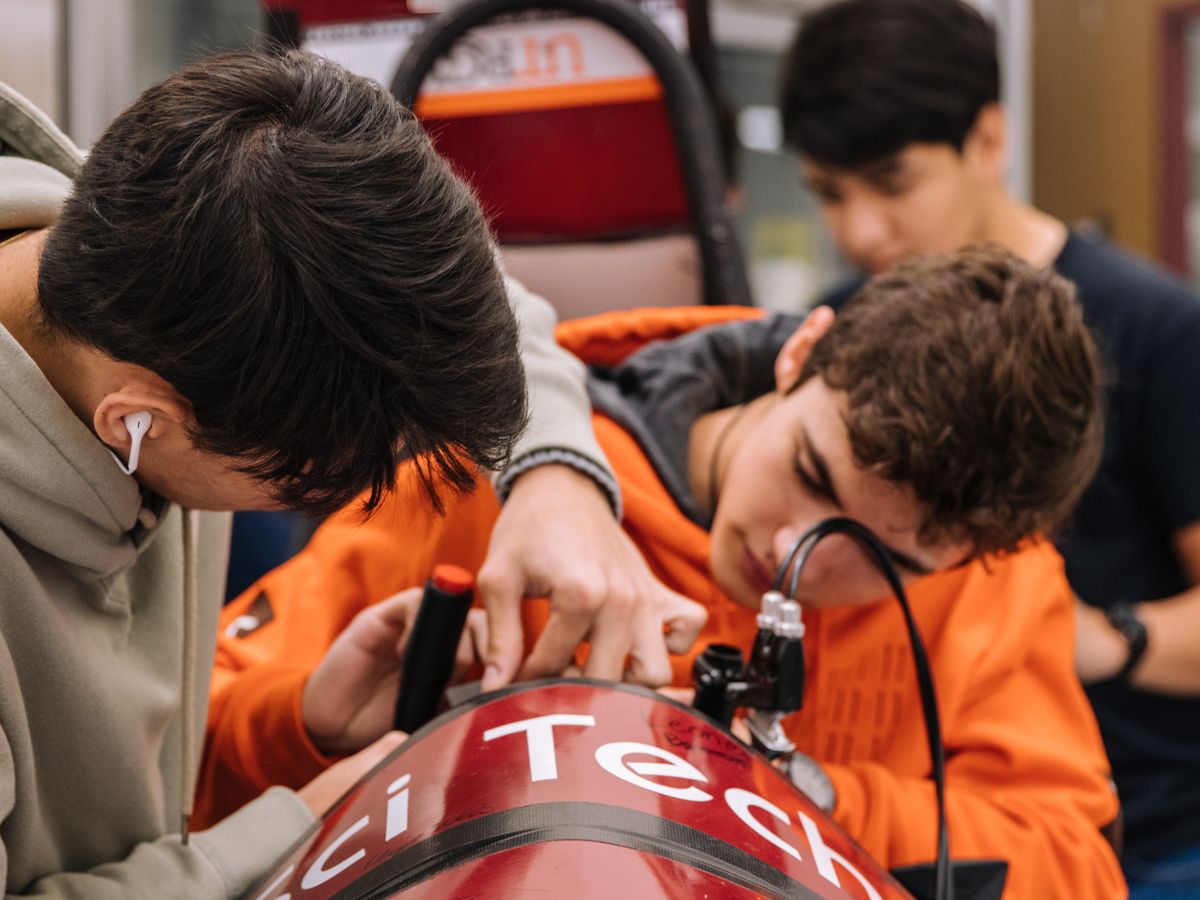
Irvine High School is one of five comprehensive high schools in the Irvine Unified School District (IUSD). Founded in 1975 and located at 4321 Walnut Avenue, it enrolls 1,925 students in the 2026-27 school year, including 483 in grade 12. The school stands out for the breadth of its curriculum rather than the number of AP courses: 25 AP courses, 47 career technical education courses, 15 dual enrollment courses offered with Irvine Valley College (IVC), and a mathematics sequence that extends to college-level multivariable calculus. This page does not rate the school. It answers one question: how a student at this school should plan the four years of high school.
How College Preparation Works at Irvine High School
Public data points to four features of this school.
First, the AP program is mid-sized, and the school does not publish scores. In May 2025, students took 1,824 AP exams. The school publishes only this figure; it does not publish the share of scores of 3 or higher or pass rates by subject. In 2024 the school earned Silver recognition on the College Board AP School Honor Roll, which recognizes schools that expand AP access while maintaining score levels.
Second, on standardized tests, the 2025 average SAT score was 1,284 and the average ACT score was 30.4; the school did not publish the number of test takers. In the Class of 2027, 9 students were named National Merit Semifinalists (the National Merit Scholarship Program selects semifinalists based on the PSAT taken in grade 11), out of 72 across the five Irvine Unified School District high schools that year.
Third, 37% of graduates go directly to four-year universities, and another 45% enroll in two-year community colleges. This four-year share is on the low end among the five district high schools. At the same time, the California School Dashboard rates the school’s College/Career Readiness at 73.6%, the highest (blue) performance level, and the 2025 graduation rate was 93.8%. Taken together, these figures show that overall preparation is solid but that a substantial share of students choose to attend a community college first and transfer later.
Fourth, career technical education is the school’s most distinctive resource. The course catalog lists 47 courses as Career Technical Education (CTE, a set of hands-on courses aligned with specific industries). Of these, 15 are offered on campus and 32 are offered after school by Coastline ROP (Regional Occupational Program). By comparison, University High School offers 12 such courses.
Year-by-Year UC Data: Applicants, Admission Rates, and GPA
The following data comes from the UC Infocenter of the University of California Office of the President. It is reported by source high school, updated annually, and currently covers 12 years from 2014 to 2025. It answers two questions: how many Irvine High School students apply and are admitted each year, and what GPA admitted students earned. GPA is the UC weighted, capped GPA, counting only courses taken in grades 10 through 11.
The ten lines are hard to tell apart where they overlap. Hover over any campus name below to highlight that campus’s trend; click to keep it highlighted, and click again to clear it.Tap any campus name below to highlight that campus’s trend; tap again to clear it.
Official UC data · By high school of origin · 2014–2025
Year-by-Year Data for the Top Six UC Campuses
Parents focus most on six University of California campuses: UC Berkeley, UCLA, UC San Diego, UC Santa Barbara, UC Irvine, and UC Davis. The table below lists, by year, the number of Irvine High School students who applied to, were admitted to, and enrolled at each campus, along with their average GPA. Use the buttons to switch between metrics.
From 2014 to 2025, the admit rate for Irvine High School applicants to UC Los Angeles fell from 26% to 8%, and to UC Berkeley fell from 24% to 8%; the rate at UC Irvine fell from 49% to 22%.
This table has five data views. Use the buttons below to view admits, applicants, enrollees, admit GPA, and applicant GPA; the button for the current view is highlighted in yellow.
| Year | UC Berkeley | UC Los Angeles | UC San Diego | UC Santa Barbara | UC Irvine | UC Davis |
|---|---|---|---|---|---|---|
| 2025Latest | 14 (8%) | 18 (8%) | 36 (16%) | 36 (21%) | 53 (22%) | 59 (36%) |
| 2024 | 16 (10%) | 15 (7%) | 31 (15%) | 53 (29%) | 70 (32%) | 49 (30%) |
| 2023 | 20 (13%) | 13 (7%) | 27 (15%) | 33 (22%) | 64 (33%) | 52 (39%) |
| 2022 | 9 (5%) | 18 (9%) | 39 (20%) | 46 (28%) | 71 (35%) | 60 (41%) |
| 2021 | 25 (18%) | 11 (7%) | 34 (19%) | 29 (21%) | 88 (43%) | 47 (38%) |
| 2020 | 24 (19%) | 12 (7%) | 65 (37%) | 59 (38%) | 48 (24%) | 51 (40%) |
| 2019 | 29 (22%) | 19 (11%) | 42 (22%) | 39 (23%) | 70 (35%) | 43 (33%) |
| 2018 | 19 (15%) | 15 (9%) | 41 (23%) | 44 (28%) | 60 (30%) | 35 (30%) |
| 2017 | 20 (15%) | 20 (13%) | 52 (33%) | 45 (38%) | 69 (38%) | 36 (34%) |
| 2016 | 19 (21%) | 20 (16%) | 44 (31%) | 49 (48%) | 67 (44%) | 36 (39%) |
| 2015 | 23 (25%) | 22 (19%) | 38 (29%) | 38 (43%) | 52 (35%) | 25 (32%) |
| 2014 | 25 (24%) | 34 (26%) | 54 (37%) | 42 (44%) | 81 (49%) | 46 (48%) |
| Change, 2014–2025 | ▼ 24% → 8% | ▼ 26% → 8% | ▼ 37% → 16% | ▼ 44% → 21% | ▼ 49% → 22% | ▼ 48% → 36% |
| Year | UC Berkeley | UC Los Angeles | UC San Diego | UC Santa Barbara | UC Irvine | UC Davis |
|---|---|---|---|---|---|---|
| 2025Latest | 175 | 219 | 223 | 169 | 236 | 163 |
| 2024 | 160 | 203 | 213 | 182 | 218 | 162 |
| 2023 | 156 | 175 | 184 | 153 | 193 | 133 |
| 2022 | 167 | 190 | 193 | 165 | 204 | 148 |
| 2021 | 138 | 169 | 180 | 139 | 206 | 124 |
| 2020 | 125 | 165 | 177 | 157 | 202 | 128 |
| 2019 | 131 | 170 | 189 | 170 | 202 | 132 |
| 2018 | 125 | 173 | 181 | 156 | 201 | 116 |
| 2017 | 134 | 155 | 160 | 118 | 184 | 107 |
| 2016 | 92 | 129 | 142 | 102 | 154 | 93 |
| 2015 | 93 | 117 | 133 | 88 | 149 | 77 |
| 2014 | 105 | 132 | 145 | 96 | 165 | 96 |
| Change, 2014–2025 | ▲ 105 → 175 | ▲ 132 → 219 | ▲ 145 → 223 | ▲ 96 → 169 | ▲ 165 → 236 | ▲ 96 → 163 |
| Year | UC Berkeley | UC Los Angeles | UC San Diego | UC Santa Barbara | UC Irvine | UC Davis |
|---|---|---|---|---|---|---|
| 2025Latest | 8 | 11 | 6 | 6 | 20 | 8 |
| 2024 | 6 | 11 | 8 | 10 | 31 | 7 |
| 2023 | 13 | 7 | 6 | 7 | 36 | 6 |
| 2022 | 5 | 13 | 8 | 10 | 32 | 11 |
| 2021 | 12 | 6 | 6 | — | 40 | 11 |
| 2020 | 12 | 7 | 17 | 8 | 21 | 9 |
| 2019 | 15 | 11 | 14 | 5 | 23 | 8 |
| 2018 | 11 | 5 | 9 | 10 | 20 | 3 |
| 2017 | 12 | 10 | 6 | 7 | 16 | — |
| 2016 | 4 | 6 | 6 | 9 | 28 | 6 |
| 2015 | 12 | 9 | 10 | 9 | 13 | 6 |
| 2014 | 14 | 17 | 7 | 6 | 17 | 5 |
| Change, 2014–2025 | ▼ 14 → 8 | ▼ 17 → 11 | ▼ 7 → 6 | 6 → 6 | ▲ 17 → 20 | ▲ 5 → 8 |
| Year | UC Berkeley | UC Los Angeles | UC San Diego | UC Santa Barbara | UC Irvine | UC Davis |
|---|---|---|---|---|---|---|
| 2025Latest | 4.18 | 4.19 | 4.21 | 4.22 | 4.15 | 4.14 |
| 2024 | 4.25 | 4.25 | 4.26 | 4.24 | 4.19 | 4.20 |
| 2023 | 4.23 | 4.28 | 4.25 | 4.23 | 4.18 | 4.17 |
| 2022 | 4.28 | 4.36 | 4.32 | 4.34 | 4.27 | 4.23 |
| 2021 | 4.27 | 4.38 | 4.28 | 4.29 | 4.15 | 4.17 |
| 2020 | 4.15 | 4.28 | 4.15 | 4.14 | 4.13 | 4.09 |
| 2019 | 4.18 | 4.22 | 4.18 | 4.17 | 4.10 | 4.14 |
| 2018 | 4.19 | 4.21 | 4.17 | 4.09 | 4.07 | 4.15 |
| 2017 | 4.24 | 4.23 | 4.20 | 4.11 | 4.16 | 4.18 |
| 2016 | 4.25 | 4.23 | 4.14 | 4.05 | 4.13 | 4.12 |
| 2015 | 4.22 | 4.24 | 4.21 | 4.04 | 4.13 | 4.07 |
| 2014 | 4.23 | 4.27 | 4.23 | 4.08 | 4.17 | 4.11 |
| Change, 2014–2025 | ▼ 4.23 → 4.18 | ▼ 4.27 → 4.19 | ▼ 4.23 → 4.21 | ▲ 4.08 → 4.22 | ▼ 4.17 → 4.15 | ▲ 4.11 → 4.14 |
| Year | UC Berkeley | UC Los Angeles | UC San Diego | UC Santa Barbara | UC Irvine | UC Davis |
|---|---|---|---|---|---|---|
| 2025Latest | 3.92 | 3.86 | 3.86 | 3.86 | 3.82 | 3.88 |
| 2024 | 3.98 | 3.93 | 3.93 | 3.95 | 3.92 | 3.93 |
| 2023 | 3.99 | 3.98 | 3.95 | 3.98 | 3.93 | 3.99 |
| 2022 | 4.09 | 4.05 | 4.04 | 4.05 | 4.01 | 4.02 |
| 2021 | 3.99 | 3.94 | 3.91 | 3.91 | 3.87 | 3.88 |
| 2020 | 3.96 | 3.92 | 3.89 | 3.88 | 3.85 | 3.85 |
| 2019 | 3.97 | 3.92 | 3.86 | 3.83 | 3.82 | 3.84 |
| 2018 | 3.94 | 3.87 | 3.82 | 3.81 | 3.76 | 3.80 |
| 2017 | 3.95 | 3.90 | 3.89 | 3.79 | 3.81 | 3.86 |
| 2016 | 3.99 | 3.91 | 3.88 | 3.77 | 3.83 | 3.84 |
| 2015 | 3.93 | 3.91 | 3.84 | 3.76 | 3.78 | 3.81 |
| 2014 | 4.05 | 3.97 | 3.91 | 3.77 | 3.85 | 3.86 |
| Change, 2014–2025 | ▼ 4.05 → 3.92 | ▼ 3.97 → 3.86 | ▼ 3.91 → 3.86 | ▲ 3.77 → 3.86 | ▼ 3.85 → 3.82 | ▲ 3.86 → 3.88 |
Applications and Admissions by Campus in the Most Recent Year
| UC campus (fall 2025) | Applicants | Admits | Admit rate | Enrollees | Admit GPA |
|---|---|---|---|---|---|
| UC Berkeley | 175 | 14 | 8% | 8 | 4.18 |
| UC Los Angeles | 219 | 18 | 8% | 11 | 4.19 |
| UC San Diego | 223 | 36 | 16% | 6 | 4.21 |
| UC Davis | 163 | 59 | 36% | 8 | 4.14 |
| UC Irvine | 236 | 53 | 22% | 20 | 4.15 |
| UC Santa Barbara | 169 | 36 | 21% | 6 | 4.22 |
| UC Merced | 89 | 89 | 100% | — | 3.79 |
| UC Riverside | 158 | 142 | 90% | 27 | 3.88 |
| UC Santa Cruz | 90 | 68 | 76% | — | 3.94 |
GPA Weighting Rules: What Is Different at Irvine High School
| Weighting rule | Only AP courses and the honors courses starred on the School Profile add 1 point, and only when the grade is C or higher. Weighted, an A counts 5 points, a B 4, a C 3, and a D still 1. |
|---|---|
| Weighted courses | All AP courses; Honors Spanish 4; Honors French 4; Honors Korean 4 / 5; Spanish for Native Speakers 2 |
| Unweighted honors courses | Honors English 1; Honors English 2; Enhanced Math 2; Honors Living Earth; Honors Chemistry of the Earth; Honors Modern World History (discontinued after the 2024-25 school year) |
| Weighting of outside courses | AP courses taken at another accredited high school are also weighted. An honors course taken elsewhere is weighted only if Irvine High School's University of California A-G course list includes a weighted course of the same name and the other school's A-G list also marks the course as weighted. Community college and university courses never receive honors weighting. |
| Class rank | Not ranked (Irvine Unified School District policy) |
| Graduation honors | Highest Honors Seven-semester academic weighted GPA of 4.000 or higher; High Honors Seven-semester academic weighted GPA of 3.800 to 3.999. Based on the seven-semester academic weighted GPA at the end of the fall semester of grade 12. At least four semesters of letter grades are required, and the GPA is not rounded. Students with a weighted GPA of 3.500 in a semester are named to the Principal's Honor Roll. |
This rule shapes course selection in grades 9 through 10. Honors English 1 / 2, Honors Living Earth, Honors Chemistry of the Earth, and Enhanced Math 2 do not raise the school GPA; the only reason to take them is preparation for later AP courses. Note that the University of California calculates GPA with its own weighting method, under which UC-certified honors courses can receive extra points, so these courses still carry value for applications; they simply do not help with graduation honors at the school. One detail that is easy to overlook is world languages: Honors Spanish 4, Honors French 4, and Honors Korean 4 / 5 are all weighted, so students who continue a language into the fourth year gain an advantage in the school GPA.
Four-Year Timeline (Based on EDUBUS Experience)
Grade 8
- March8th Grade Family Night
- March 2Course Pathways parent meeting (online)
- Mid-AprilSubmit the grade 9 elective form
- May 7Incoming freshman athlete information meeting
- AugustRoundup: pick up schedule, student ID, and textbooks
Grade 9
- October 15PSAT 8/9 on campus
- Throughout the yearTwo 90-minute counselor classroom lessons on the four-year plan and a career interest assessment
- March 13Enter next year's courses in the Aeries Academic Plan; deadline 3:00 p.m.
Grade 10
- September to AprilHigh School Planning Conference, attended by the student and parents
- OctoberPre-ACT on campus
- Week of March 24Teacher advisor meetings to confirm grade 11 courses
Grade 11
- OctoberPSAT/NMSQT, the National Merit qualifying test
- FebruaryGrade 11 information night
- April 11Final Academic Plan changes due; the plan closes at 3:00 p.m. until August
- MayPrivate college and recommendation letter workshop, financial aid presentation, and required grade 11 meetings
Grade 12
- September 14Required grade 12 meeting; counselor recommendation letter requests open the same day
- October 9Counselor recommendation letter requests due
- October 1FAFSA and CADAA applications open
- October 7 to November 20Application workshops
- November 30University of California and California State University application deadline
- March 2Cal Grant deadline
- May 1Statement of Intent to Register (SIR) deadline
- July 1Send final transcripts through Parchment
Three milestones determine the direction of a student’s path: math placement in the spring of grade 8, which determines entry into Enhanced Math 2; the High School Planning Conference in grade 10, which determines the AP combination for grades 11 through 12; and the counselor recommendation letter request window from September 14 to October 9 of grade 12. The first two are difficult to recover from if missed, and once the third window closes, counselors no longer accept new requests.
Clubs and Academic Competitions
Irvine High School has 131 registered clubs in the 2026-27 school year. Its strengths in academic competitions are concentrated in aerospace, engineering, and science.
18 academic and competition clubs6 of these clubs have a matching competition guide on this site
- Science OlympiadScience Olympiad (Division B & Division C)
- Model United NationsModel United Nations (NHSMUN and major California conferences)
- Speech and Debate
- Computing Olympiad (USACO focus)USA Computing Olympiad
- Physics OlympiadF=ma Exam and U.S. Physics Olympiad (USAPhO)
- Biology Competition Club
- CyberPatriot cybersecurity competition club
- FRC Robotics Club (FIRST Team 7230)FIRST Robotics Programs (FIRST LEGO League / FIRST Tech Challenge / FIRST Robotics Competition)
- Quiz Bowl
- National History Day ClubNational History Day (NHD)
- Rocketry and Aviation Engineering Association
- Girls Who Code
- Underwater Robotics Club (UROV)
- Irvine Business Association / Personal Finance Club / AI & Investment Club
- Student Science Network / Junior Science Mentors / Irvine Bio Tech Club
- Creative Writing Club
- Chess Club
- California Scholarship Federation, National Honor Society, Tri-M Music Honor Society, and the French and Spanish honor societies
Notable results include a 2024 national championship in the StellarXplorers space system design competition, with three additional teams placing in the national top ten; a 16th-place finish among 6,500 teams in the National Economics Challenge; a national top-18 finish in the Virtual Enterprise national business plan competition; and a CubeSat that students assembled, tested, and launched into low Earth orbit. The 2026-27 club list does not include the following: Math club and AMC (American Mathematics Competitions) preparation, FBLA (Future Business Leaders of America), DECA, Mock Trial, Academic Decathlon, HOSA (Future Health Professionals). Students who want to take part in these competitions need to do so through outside organizations.
Signature Programs
- Career Technical Education (CTE) and Coastline ROP: The Course of Study marks 47 courses as Career Technical Education, the most among the five comprehensive high schools in Irvine Unified School District. Fifteen are offered on campus, covering engineering (PLTW), computer science, web design, business and entrepreneurship, automotive technology, fashion design, and technical theater. The other 32 are Coastline ROP after-school courses in areas such as culinary arts, medical, dental, emergency medical response, animal care, criminal justice, and fire science. These courses are free, most count as UC A-G area g electives, and they are intended mainly for students in grades 11-12.
- PLTW Engineering and Aerospace Programs: Introduction to Engineering Design, Principles of Engineering, Aerospace Engineering, and Engineering Design and Development all count toward UC A-G area d laboratory science. Related programs include FIRST Robotics Team 7230; Irvine CubeSat, in which students assembled, tested, and launched a CubeSat into low Earth orbit; the StellarXplorers space system design competition (2024 national champion); and a Society of Women Engineers chapter.
- Irvine Valley College (IVC) Dual Enrollment: The Course of Study lists 15 dual enrollment courses. CCAP (College and Career Access Pathways) courses are free; some meet on campus during the regular school day or zero period, and they are open to grades 9-12. Grades are recorded on the college transcript. Only courses that satisfy high school graduation or UC A-G requirements are posted to the high school transcript, and they are posted only after the Cal Grant GPA is submitted in the fall of grade 12. These courses receive no honors weighting and do not count toward the school GPA.
- Music and Media: The instrumental music program holds the GRAMMY Signature Schools Gold designation, placing it among the top ten in the nation, with more than 500 students participating and a 200-member marching band; choir has more than 200 students and theater more than 100. The student newspaper, El Vaquero, was ranked first by the Orange County Journalism Education Association, and the school also offers iTV, a campus television program, and yearbook courses.
- AVID: A selective program for students with a GPA between 2.0 and 3.5. Admission requires an application and an interview, participants must take at least one AP or honors course at the same time, and the course counts as UC A-G elective credit.
- Teacher Advisement: Each student is assigned a teacher advisor, and counselors are also assigned by teacher advisor. A weekly Flex period gives students set time to meet with teachers for help, and family course-selection conferences are held in the teacher advisor's classroom.
How to Use the College and Career Center
| Planning platform | The school uses CaliforniaColleges.edu as its official planning platform. Grade 11 students must create an account, which can be imported directly into the University of California, California State University, and community college applications. The four-year course plan is recorded in the Aeries Academic Plan, and transcripts are requested through Parchment. |
|---|---|
| College and Career Center | The College and Career Center is located in the library and staffed by a dedicated college and career specialist; it also handles Coastline ROP course registration. Counselors accept student drop-ins daily at lunch, and longer meetings require an appointment. |
| Recommendation letters | For 2026-27, the window to request a counselor recommendation letter is September 14 to October 9, 2026, and requests must be made no later than three weeks before the earliest application deadline. The process has six steps: request the letter from the counselor in person, invite the counselor in the Common App, complete the recommendation questionnaire, submit a résumé, review the transcript in Aeries, and schedule a meeting while indicating the application round in the Common App. Students request teacher recommendation letters directly from their teachers. The University of California and California State University applications require neither recommendation letters nor transcripts. |
| On-campus testing | Grade 9 students take the PSAT 8/9 on campus on October 15; grade 10 students take the Pre-ACT in October in their teacher advisor's classroom, with no registration required; grade 11 students take the PSAT/NMSQT in October, the qualifying test for the National Merit Scholarship Program. |
| College visits | In the fall, college admission representatives visit campus during Flex periods and lunch. The Irvine Unified School District College and Career Fair takes place on October 5, 2026 at Portola High School. |
| Community college | Irvine Valley College holds admission advising every Monday at lunch in the College and Career Center (LIFE Center, located in the library). IVC Spotlight Week takes place in November, and the Freshman Advantage information session for incoming college freshmen takes place on May 4. |
For the requirements of each course, see Courses and Course Selection. For math acceleration pathways and college-level dual enrollment mathematics, see Math Pathways. For the grade levels and recommended combinations of the 25 AP courses, see AP and Course Selection Strategy.
Frequently Asked Questions
Within the Irvine Unified School District, what kind of student is Irvine High School a good fit for compared with University High School?
The two schools serve different profiles. University High School has larger academic competition clubs and a larger AP program, and 53% of its graduates go directly to four-year universities. Irvine High School offers 25 AP courses, 47 career technical education courses, and 15 community college dual enrollment courses; 37% of its graduates go to four-year universities and 45% start at a community college. Students with a clear goal of reaching the most selective universities need to plan acceleration more deliberately at Irvine High School. Students who want to build experience in career fields such as engineering, health care, or business, or who plan to transfer from a community college, will find more course resources at Irvine High School.
Do honors courses at Irvine High School receive extra weight in GPA calculations?
Only some of them. Irvine High School adds 1 point only for AP courses and for courses marked with an asterisk on the school profile, including Honors Spanish 4, Honors French 4, Honors Korean 4 / 5, and Spanish for Native Speakers 2. Honors English 1 / 2, Enhanced Math 2, Honors Living Earth, and Honors Chemistry of the Earth are not weighted.
What GPA do Irvine High School students admitted to the University of California typically have?
According to data published by the University of California Office of the President by source high school, the average weighted GPA of Irvine High School students admitted for fall 2025 was 4.22 at UC Santa Barbara, 4.21 at UC San Diego, 4.19 at UCLA, 4.18 at UC Berkeley, 4.15 at UC Irvine, and 4.14 at UC Davis. These figures use the UC weighted, capped GPA for grades 10 and 11. In the same year, 251 students applied systemwide and 191 were admitted.
What will change after the Woodbury community is assigned to Irvine High School?
The Irvine Unified School District Board of Education has approved an attendance boundary change: students from the Woodbury community will attend Irvine High School beginning in fall 2028. At a parent meeting, the school stated that enrollment is expected to grow from about 1,900 to about 2,400 students and that it plans to hire about 15 additional teachers and staff. For Irvine families whose students are now in the upper elementary grades, this means the number of sections and the course offerings at Irvine High School will be adjusted over the next few years, and competition for popular courses will be stronger than it is today.
Do career technical education (CTE) courses at Irvine High School affect college applications?
They do not take the place of academic courses, and they can add hands-on experience to an application. A substantial share of the 47 career technical education courses at Irvine High School count toward the University of California A-G requirements: 4 PLTW engineering courses count as category d laboratory science, and 17 Coastline ROP courses count as category g electives. All 32 Coastline ROP courses are held after school and do not use regular class periods. These courses are not weighted and cannot replace the core mathematics and science sequences, so students should schedule their A-G courses first and add CTE courses afterward.