
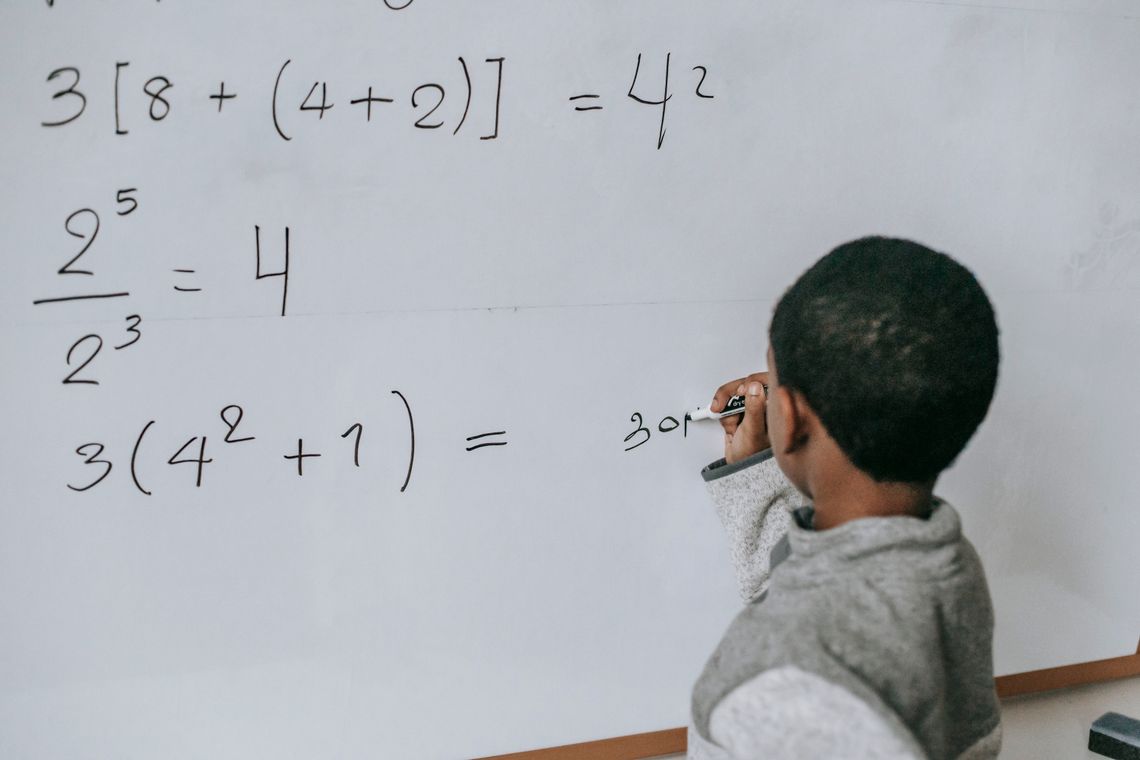
This is not one course but three linked stages from grade 3 through high school: build contest instinct in elementary school, spend the middle school years on the American Mathematics Competition 8 (AMC 8), then turn results in high school into an honor a college application can name. The 2026-27 year runs in two terms, 31 August to 20 December 2026 and 4 January to 30 May 2027, 35 weeks in total. Classes are led by mathematics PhDs, including instructors who teach at the University of California.
EDUBUS Math Competition Pathway: What this path fixes
Families usually notice one of two things. A student earns A grades in school mathematics but solves only seven or eight problems on a first AMC paper. Or every problem looks solvable in isolation, yet 25 of them do not fit into 40 minutes. Both point to the same gap: school mathematics rehearses known procedures on known problem types, while contest mathematics asks a student to recognize structure in an unfamiliar setting, choose a route, and manage the clock. That gap does not close on its own as the school sequence advances.
Math placement differs across Irvine Unified School District (IUSD) schools, so two students in the same grade can start a full level apart. We place by assessment rather than by grade level. Sequences differ by school, so the assessment matters more than the grade on the transcript.
EDUBUS Math Competition Pathway: Three stages
- Elite Math Track (grades 3-5): unpack the content behind elementary contests on our own training platform, aimed at Math Kangaroo USA and Math League, feeding into the AMC 8 track. 35 weeks, 2 hours per session, about 3 contest entries.
- AMC Accelerator (grades 6-8): middle school is the window that sets the ceiling. The course runs through the AMC 8 syllabus with timed mocks; entries are Math League, Math Kangaroo USA and BmMT. 35 weeks, 2 hours per session, about 3 contest entries.
- AIME Pathway (grades 9-11): the route from a strong AMC score to AIME qualification to an invitational record. Entries are AMC 10/12 and AIME, plus HMMT, SMT, BMT, DMM and CHMT. 35 weeks, 2 hours per session, 3 to 4 contest entries.
Three published lines
Every level here has a published MAA threshold you can check against the official site. See what has to be cleared before choosing where to start.

Photo: Jena Backus / Pexels AMC Accelerator · Grades 6-8
25max score
AMC 8American Mathematics Competition 8
- 25 questions / 40 min
- 1 point each
- no calculator
Top 1% nationally earns Distinguished Honor Roll; top 5% Honor Roll.
This season21-27 January 2027Format and entry →

Photo: Monstera Production / Pexels AIME Pathway · Grades 9-12
100 / 85AIME cutoff
AMC 10/12American Mathematics Competitions 10/12
- 25 questions / 75 min
- 150 max
- no penalty for wrong
correct6blank1.5wrong0
A blank outscores a wrong answer, so leaving an uncertain question blank beats guessing. This is where points are lost every year.
This season5 and 13 November 2026Format and entry →

Photo: kaboompics.com / Pexels After qualifying
15max score
AIMEAmerican Invitational Mathematics Examination
- 15 questions / 3 hours
- answers are integers 000-999
- no penalty
From 2027 it runs on computer at Pearson centers, booked by the student. The score now drives USAMO and USAJMO selection.
This season5 and 6 February 2027Format and entry →
EDUBUS Math Competition Pathway: Two rule changes for the 2027 season
Both shift where preparation time should go, and much of the material circulating locally has not caught up.
First, from 2027 the AIME is delivered on computer at more than 200 Pearson Professional Centers across the United States and Canada, with qualifying students booking their own seat rather than sitting the exam at school. Qualifying is no longer the last step a family has to take, and a missed booking has no second sitting.
Second, MAA has announced that USAMO and USAJMO qualification for 2027 rests primarily on the AIME score, with AMC scores no longer a selection factor. The old route of a high AMC score paired with a middling AIME no longer works, so olympiad-bound students should move their effort from multiple-choice speed toward depth on AIME-style problems.
EDUBUS Math Competition Pathway: How the season is laid out
- 5 November and 13 November 2026: the AMC 10/12 A and B papers. A student may sit both and keep the higher score.
- 21 to 27 January 2027: the AMC 8 testing window.
- 5 and 6 February 2027: the AIME.
AMC 8 and AMC 10/12 registration runs through a site with a registered MAA Competition Manager; students cannot enter on their own. EDUBUS is an official site for both, and registration goes through our own channel for AMC 8 and AMC 10/12. AIME is different: qualifiers book their own Pearson seat.
EDUBUS Math Competition Pathway: Class levels
Each stage runs an A and a B section with identical content at different times. Placement is by assessment.
| Section | Stage | Meets |
|---|---|---|
| Beginner A | Elite Math Track, grades 3-5 | Sat 10:00-12:00 |
| Beginner B | Elite Math Track, grades 3-5 | Sat 14:30-16:30 |
| Intermediate A | AMC Accelerator, grades 6-8 | Sat 16:45-18:45 |
| Intermediate B | AMC Accelerator, grades 6-8 | Sun 17:00-19:00 |
| Advanced A | AIME Pathway, grades 9-11 | Sat 12:30-14:30 |
| Advanced B | AIME Pathway, grades 9-11 | Sun 15:00-17:00 |
Times are the autumn 2026 arrangement and may shift each term; the schedule confirmed before classes start governs.
Contests covered include AMC 8/10/12, AIME, Math Kangaroo USA, Math League, CML, MOEM, BmMT, and university invitationals including the Harvard-MIT Mathematics Tournament (HMMT), the Stanford Math Tournament (SMT), the Berkeley Math Tournament (BMT) and the Duke Math Meet (DMM). We do not enter everyone in the same contests; students are matched to the track where they can actually score. Formats and dates for all of them are in the math competition guide.
EDUBUS Math Competition Pathway: Summer intensive
 Photo: Monstera Production / Pexels
The AMC summer intensive is for grades 7 to 10 in classes of 8 to 10, two weeks per session, Monday through Friday, offered in two sessions and built to feed the fall AMC 8/10/12 sessions. Cover the syllabus intensively over the summer, then consolidate and close gaps during the school year.
EDUBUS Math Competition Pathway: What pairs with it
Beyond individual papers, high school students need two things that solo practice cannot build: team-round coordination and written proof. University invitationals score by team and include proof rounds that require a complete written argument. Both are trained in Sigma Circle, which runs alongside AIME Pathway. Students who also want to lift their school grade can pair this with K-12 math.
How to Start EDUBUS Math Competition Pathway
Start with a placement assessment. We use it to set the level and class, then confirm the year plan with the family. For schedules, tuition, and bundle offers, request the 2026-27 program guide through the form below.
Want to talk to a course advisor now?
Contact a course advisorMath Competitions: Frequently Asked Questions
What grade should Irvine students start competition math in?
Grade 3 is early enough. Elite Math Track serves grades 3 to 5 over 35 weeks with about three competition entries; AMC Accelerator takes grades 6 to 8 into the AMC 8 sprint; AIME Pathway carries grades 9 to 12 through AMC 10/12 and into university invitationals.
Can Irvine students take AMC 8 and AMC 10 in the same year?
Yes, and many students do both in grade 8. AMC 8 is for students in grade 8 or below who are under 14.5 on test day; AMC 10 is for grade 10 or below, under 17.5, with no lower grade limit. The two sit in the fall and the following January, so they do not clash.
What score qualifies for AIME?
The Mathematical Association of America (MAA) published 100 on AMC 10 and 85 on AMC 12 for the 2026-27 cycle. These are fixed published cutoffs, not percentiles, and they are announced each year, so check the official site. Qualifying for AIME is the threshold admissions readers recognize.
How do Irvine public high school students fit training in?
Summer concentrates the content and the school year consolidates it. The two-week summer intensives serve grades 7 to 10 in groups of 8 to 10 and cover the tested material; the fall classes then work through past papers and remaining gaps. Schools in Irvine Unified School District (IUSD) move through math at different paces, so placement follows the entry assessment rather than school grade level. See the IUSD high school guide for course listings.
Does every student enter the same competitions?
No; we do not register everyone for the same contests. The track covers AMC 8/10/12, AIME, Math Kangaroo USA, Math League, CML, MOEM, BmMT, and university invitationals including HMMT, SMT, BMT, DMM, and CHMT. Students are matched to where they can actually score rather than entered across the board.
What should high school students add beyond AMC?
Team competition and proof writing. AMC and AIME are timed individual papers, while university invitationals score by team and include rounds requiring a full written argument, and neither skill comes from solving problems alone. Both are covered by the Sigma Circle math club, taught in small groups in Irvine and online.