
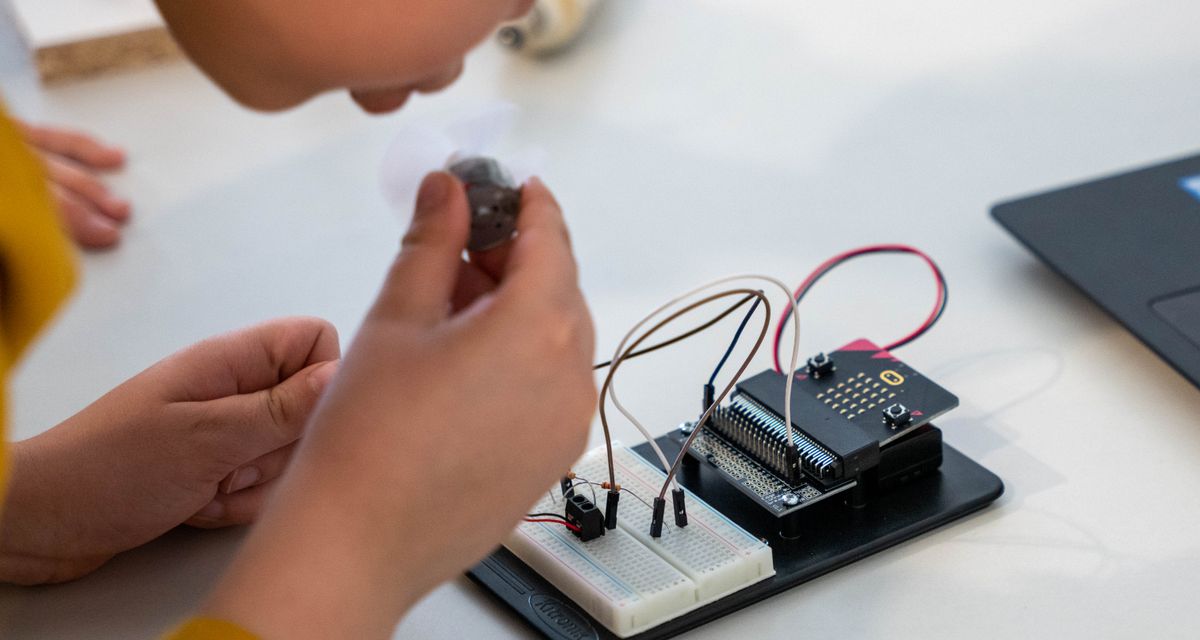
Little Makers Science is for grades 1 to 3. Rather than asking children to produce a pretty finished product, the course focuses on teaching them to make something, assess it themselves, and then make it better. The year runs 35 weeks.
The Full Cycle of One Little Makers Project
Every project follows the same four steps. The number of times a child repeats the cycle matters more than the project itself.
- Ask a question: How can a toy car travel farther? How can a bridge hold more coins? How can a paper airplane fly more steadily?
- Build: The child makes a first version from everyday materials. The goal is not for it to look good but for it to work.
- Self-assessment: The child tests it, records the results, and says what is not working. In this step the teacher only asks questions and does not give answers.
- Improve: The child changes one thing, tests again, and checks whether the result changed.
Why Little Makers Does Not Aim for “Pretty”
Young children often treat “looking nice” as the goal and give up as soon as a first version disappoints them. The course deliberately sets the standard at “can you explain clearly what needs to change”. This helps children get used to the idea that work can be revised, rather than succeeding or failing in one attempt. The habit returns again and again later, in academic writing, science experiments and engineering projects. It is also the earliest hands-on foundation that the entrepreneurship and financial literacy track needs.
What Parents Will See from Little Makers
A child may bring home a toy car that runs crooked. The same child can also explain that it was revised three times and what changed each time. That explanation is the real outcome of the course.
What to Take After Little Makers
From grade 5, students who want to keep doing engineering projects can continue with Science Olympiad Engineering. Students interested in mechanics and coding can continue with VEX IQ Robotics Intro. Students interested in flight and structures can join Rocketry Design Intro from grade 7.
Little Makers Enrollment and Schedule
Creative workshops come in three enrollment units: full-year classes, term classes, and summer camps. This course runs as follows; dates follow the 2026-27 program guide.
- Full-year class: 35 weeks, August 31, 2026 to May 30, 2027; once a week, 90 minutes per session.
- Switching direction: a creative workshop seat can move between directions, so a child can try 3 to 4 areas in a year, with finished work shown and discussed with parents at the end of each stage. To switch, confirm the transfer timing with a course advisor.
Want to talk to a course advisor now?
Contact a course advisorLittle Makers: Frequently Asked Questions
What is the focus of this class?
The process rather than how polished the result looks. Students make something, judge it themselves, and then make it better, repeating that loop until building and revising becomes routine. For grades 1 to 3 the point is the habit, not an impressive object to take home.
What if my child's project does not turn out well?
A pretty product was never the goal. The self-assessment step asks a child to say out loud what is not working and then go back and change it, and that loop is precisely the ability the course sets out to train, so an imperfect first attempt is useful rather than wasted.
What grades in Irvine is this for?
Grades 1 to 3, running 35 weeks. EDUBUS is based in Irvine and runs this course as a small in-person group with an online section at the same time. Workshops enroll in rolling short terms, so one seat lets a child rotate through 3 to 4 domains over the year.
How does this help Irvine students later?
It quietly builds the hands-on habits that academic work and the entrepreneurship and financial literacy track will draw on later. Building, assessing and revising is a cycle that returns in every engineering and project-based course further up, and it sits alongside the science and project work children already do at school.
What do Irvine students take next?
It depends on the direction. For more engineering projects, Science Olympiad Engineering takes grades 5 to 8 and works under real resource constraints. For robotics, VEX IQ Robotics Intro combines electronics, mechanics and coding, with sections starting from grade 1.