
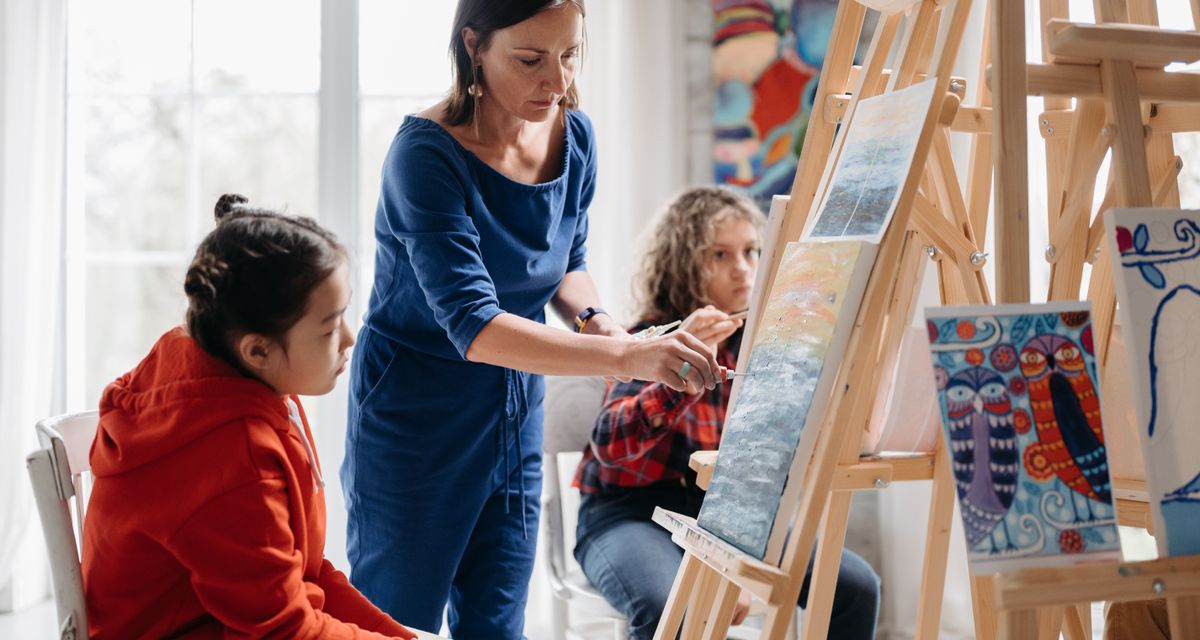
For most children, Oil Painting for Kids is their first time working with formal art materials. Unlike watercolor, oil paint does not set the moment it touches the surface. It can be painted over and revised again and again. This quality is itself a form of training: children must think before they paint, and a mistake does not mean starting over. Each term has 12 lessons.
What Happens in Oil Painting Class
- Getting to know the materials: The differences between oil brushes, palette knives, canvas, and painting mediums, as well as how to clean brushes and put materials away. These habits are set in the first lesson.
- Color mixing: Mixing the colors they need from the three primary colors, and understanding value (how light or dark a color is) and warm and cool colors, instead of using paint straight from the tube.
- Brushwork and layers: Learning the difference between thin and thick application, and laying in large areas of color before handling details. This builds a working order that moves from the whole picture to its parts.
- Completing a painting: One painting is completed over several lessons. Partway through, it is hung up so students can see the overall effect and make adjustments.
What Students Take Home from Oil Painting
Each term, students complete at least one oil painting that is ready to frame and display. More important than the painting is a child’s tolerance for work that is not yet finished. Oil paint must be left to dry and must be built up over several sessions. This process is completely different from the instant satisfaction of a sketching class, and it asks more of a child’s focus.
What Background Oil Painting Requires
No drawing background is needed. It is recommended, however, that children have some prior art class experience and can work quietly on a piece for 60 minutes or more. Children under 8 should start with Early Art: Miro, Spring Paddy & Picasso Classes. The studio provides the painting materials. Children only need to wear old clothes or bring their own smock.
What to Take After Oil Painting
Children who enjoy drawing figures and characters can switch to Digital Arts. Those who enjoy storytelling can move on to Picture Book Design. Those who want to turn images into photographs can look at the Youth Photography Lab.
Oil Painting Enrollment and Schedule
Creative workshops come in three enrollment units: full-year classes, term classes, and summer camps. This course runs as follows; dates follow the 2026-27 program guide.
- Term class: 12 lessons per term, in one fixed time slot chosen from the timetable.
- Switching direction: a creative workshop seat can move between directions, so a child can try 3 to 4 areas in a year, with finished work shown and discussed with parents at the end of each stage. To switch, confirm the transfer timing with a course advisor.
Want to talk to a course advisor now?
Contact a course advisorOil Painting: Frequently Asked Questions
Can an Irvine child join with no painting experience?
The class is designed as a first encounter with formal materials, so it starts from the materials themselves and assumes no earlier training. The class meets in person in Irvine, with an online section running in parallel. Children under 8 are better placed in Early Art, which takes ages 3 to 8, and can move here once they are ready.
What age in Irvine is this for?
Ages 8 to 10. Hand control and attention span at this age are usually enough to work with real oil painting materials and to stay with one canvas over several sessions, which is why the introduction is placed here rather than earlier.
How long is a term?
12 lessons. The workshop, open to students from Irvine and nearby communities, enrolls in rolling short terms, so one seat lets a child rotate through 3 to 4 different domains in a year, each term ending with finished work.
How is this different from earlier art classes?
The materials, and how the work proceeds. Early art classes work on creativity in its rawest form and are not about technique, while this course puts formal painting materials in a child's hands for the first time and sets clearer expectations for a finished piece.
What comes next for an Irvine student?
It depends on the direction a child wants to take. Picture Book Design, also for ages 8 to 10, puts drawing to work on a story and ends in a bound book, while Digital Arts, for ages 8 to 12, moves the same skills onto a screen.