

In short: The University of Notre Dame in Indiana, founded in 1842, enrolls 8,923 undergraduates. It received 36,104 applications for the Class of 2030 and admitted 9%; testing stays optional for fall 2027 entry, and families earning up to $150,000 receive at least full tuition.
- Location
- University of Notre Dame, Notre Dame, IN 46556
- Founded
- 1842
- Acceptance Rate
- About 9% (Class of 2030: 36,104 applications)
- Official Website
- www.nd.edu
Application timelineper school website
- Restrictive Early Action applicationDeadline
- REA supporting documents, SlideRoom portfolios, and financial aid priority date (FAFSA, CSS Profile, IDOC)Deadline
- REA decisions (admit, not selected, or deferred to Regular Decision)
- Regular Decision applicationDeadline
- RD supporting documents, SlideRoom portfolios, and financial aid priority dateDeadline
- RD decisions
- Admitted students confirm enrollment and pay the $500 depositDeadline
Overview
The University of Notre Dame sits in Notre Dame, Indiana. It was founded in 1842 by Rev. Edward Sorin of the Congregation of Holy Cross and is a Catholic research university. It enrolls 8,923 undergraduates and 4,206 graduate and professional students, with an 8:1 student-to-faculty ratio. Ninety-nine percent of students return for their second year, and 95% graduate on time. In the enrolled Class of 2030, 81% of students are Catholic, 9% are international, and 15% come from the western states.
Two kinds of families tend to fit. In the first, the family is comfortable with the university’s Catholic mission and wants a fully residential four years centered on a residence hall community. In the second, the student is academically strong and has a sustained record of service and community involvement, because Notre Dame’s short-answer prompts and review criteria ask about exactly those qualities. For Irvine families, the questions to settle early are where the testing policy changes and how an early application fits alongside the University of California; the last section of this page lays that out by grade.
Admissions data
Notre Dame publishes the total number of applications and the admit rate for the Class of 2030, but not the number of admitted or enrolled students, so this page does not draw an applied-to-enrolled funnel. The Class of 2030 drew 36,104 applications, the admit rate was 9%, and the yield (the share of admitted students who enroll) was 65%. Applicants came from all 50 states, the District of Columbia, five US territories, and 183 countries.
- Arts, humanities, and social sciences26%
- Business24%
- Engineering22%
- Science22%
- Architecture3%
- Global affairs3%
- Midwest38%
- Northeast22%
- Southeast17%
- West15%
- Southwest8%
The five regions sum to 100%; Notre Dame does not say how international students are counted.
In the Restrictive Early Action round, Notre Dame reviewed 13,711 applications and admitted 1,617 (12%); another 2,608 (19%) were deferred to Regular Decision. Among enrolled students who submitted scores, the middle 50% range was 1460 to 1540 on the SAT and 33 to 35 on the ACT. Twenty-one percent of the enrolled class are first-generation college students or Pell Grant recipients, 55% receive need-based aid, and more than 70% receive some form of financial aid.
How to apply
Restrictive Early Action
REA- Deadline
- November 1
- Decisions
- Mid-December
- Non-binding; admitted students may wait until May 1 to decide
- Early Action at other public or private colleges is allowed; binding Early Decision 1 anywhere is not
- Early Decision 2 is allowed after REA decisions; if admitted ED2, withdraw from Notre Dame at once
- A student denied in REA cannot reapply in Regular Decision; REA applicants get priority for merit scholarships
Regular Decision
RD- Deadline
- January 4
- Decisions
- Mid- to late March
- Also non-binding; outcomes are admit, not selected, or waiting list
- Supporting documents, SlideRoom, and financial aid priority date: January 15
- Waiting list students receive a final decision by mid-summer
- Admitted students confirm and pay a $500 deposit by May 1
Notre Dame accepts the Common Application, the Coalition Application on Scoir, and the QuestBridge application. The application fee is $85, and fee waivers are available based on financial need. Materials include the main application and personal essay; the Notre Dame Writing Supplement, which has one required essay of up to 150 words and two short answers of 50 to 100 words each, chosen from four prompts on faith, personal background, service to others, and “What would you fight for?”; the full high school transcript; and one letter of evaluation from a teacher in a core academic subject. Notre Dame highly recommends that the school counselor submit a second letter and asks for only one teacher letter. Students interested in art, music, or architecture may submit work through SlideRoom.
Testing policy comes in two stages. The 2026-27 cycle (fall 2027 entry) is test-optional, which means applicants may apply without SAT or ACT scores. Beginning with the 2027-28 cycle, first-year and transfer applicants seeking to enroll in fall 2028 must submit either the ACT or the SAT. Notre Dame has no preference between the tests, the ACT Science and Writing sections are optional, and scores from multiple sittings are superscored by section. Applicants may self-report scores; admitted students must send official scores that match before enrolling. International applicants must also submit proof of English proficiency.
Interviews are not part of Notre Dame’s evaluation, and there are no alumni interviews. Each region has an assigned admissions counselor whom applicants can contact directly. Admission is need-blind for all applicants, domestic and international, which means an aid application never affects the decision, and Notre Dame commits to meeting 100% of each family’s demonstrated need.
Cost and financial aid
- Tuition$69,280
- Fees$514
- Housing and food$18,992
What aid covers, by family income
- Up to $60,000 (most families)$0Tuition, fees, housing, and food covered
- Up to $150,000Tuition $0Aid covers at least full tuition
- Up to $200,000Aid covers at least half of tuition
- Above $200,000Full demonstrated need is met
Notre Dame’s undergraduate aid program is called Pathways to Notre Dame and is built mainly on need-based aid; the university also awards merit scholarships, for which REA applicants receive priority consideration. Need-based offers consist only of grants and scholarships that do not have to be repaid, with no loans; a family may still choose to borrow on its own. To estimate what a family can contribute, Notre Dame looks at income, assets (excluding qualifying retirement accounts), and certain expenses such as private or parochial school tuition, local cost of living, family size, and the number of children in college. As long as a family’s finances stay substantially the same, aid stays consistent for four years. US applicants should submit the FAFSA, CSS Profile, and IDOC documents by the priority date; international applicants seeking need-based aid complete the CSS Profile.
Schools and fields of study
Notre Dame has eight colleges and schools. Six of them offer undergraduate programs: the College of Arts and Letters, the College of Science, the College of Engineering, the Mendoza College of Business, the School of Architecture, and the Keough School of Global Affairs; the other two are the Graduate School and the Law School. Arts and Letters is the oldest and largest college and offers much of the core curriculum. Notre Dame reports 75 undergraduate majors; the map below is organized from the 66 undergraduate programs listed in its program directory.
10fieldsEngineering and computingShow all
- Aerospace Engineering
- Chemical Engineering
- Civil Engineering
- Computer Engineering
- Computer Science and Engineering
- Computer Science (Arts and Letters)
- Electrical Engineering
- Environmental Engineering
- Environmental Earth Sciences
- Mechanical Engineering
16fieldsNatural sciences and mathematicsShow all
- Applied and Computational Mathematics and Statistics
- Mathematics
- Statistics
- Physics
- Physics in Medicine
- Chemistry
- Chemistry/Business
- Chemistry/Computing
- Biochemistry
- Biological Sciences
- Environmental Sciences
- Neuroscience and Behavior
- Preprofessional Studies
- Pre-Health (Arts and Letters)
- Science-Computing
- Science-Education
7fieldsBusiness, architecture, and global affairsShow all
- Accountancy
- Finance
- Information Technology, Analytics, and Operations
- Management & Organization
- Marketing
- Architecture
- Global Affairs
6fieldsSocial sciencesShow all
- Economics
- International Economics
- Political Science
- Psychology
- Sociology
- Anthropology
27fieldsHumanities and artsShow all
- English
- History
- Philosophy
- Theology
- Philosophy and Theology
- Program of Liberal Studies
- Classics
- Greek and Latin
- Medieval Studies
- American Studies
- Africana Studies
- Latino Studies
- Gender Studies
- Art History
- Design
- Studio Art
- Music
- Film, Television, and Theatre
- Chinese
- Japanese
- Arabic Studies
- French and Francophone Studies
- German
- Italian Studies
- Russian
- Spanish
- Romance Languages and Literatures
Every undergraduate completes the university Core Curriculum: six general liberal arts courses covering quantitative reasoning, science and technology, art and literature or advanced language and culture, history or social science, and an integration course; four courses in the explicitly Catholic dimensions of the liberal arts, namely two in theology and two in philosophy (the second may be a Catholicism and the Disciplines course); two writing courses, one of them the first-year University Seminar; and the two-semester Moreau First Year Experience. Each college adds its own requirements on top of the core, students complete only the requirements of the college that houses their primary major, and some majors have courses that must be taken in the first year.
Business admission works differently from the other colleges. Applicants indicate a non-binding intended college and major; those who choose business learn at admission whether they are pre-approved for Mendoza, and students without pre-approval may enroll in another college, though their chances of moving into business after the first year are extremely limited. There are alternatives outside Mendoza, including the Economics and International Economics majors in Arts and Letters, five-year bachelor’s and MBA programs for students in Science and Engineering, and minors that Mendoza opens to other students, such as accountancy, digital marketing, and innovation and entrepreneurship. In the Class of 2030, 24% of enrolled students listed business as their interest and 22% each listed engineering and science. Notre Dame also reports that 33% of undergraduates take part in research and 91% of classes have fewer than 50 students.
Campus life
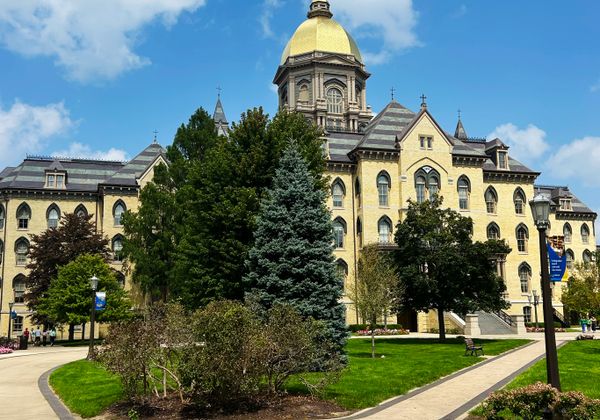
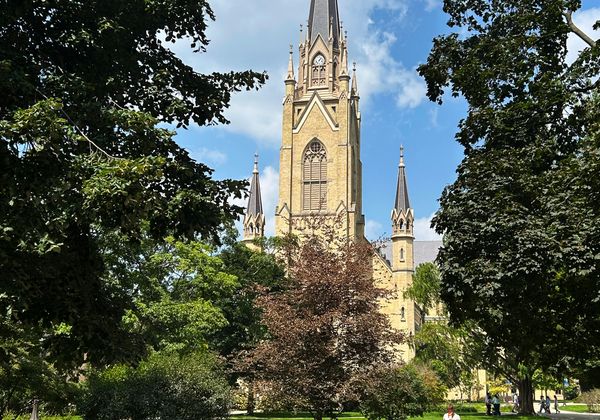

Notre Dame is fully residential, with 33 undergraduate residential communities on campus. Each hall has its own history, traditions, rector, chapel, mascot, colors, and signature event. Halls are single-sex and mixed-class, and students typically stay in the same hall for their time on campus. Every first-year student receives an on-campus assignment with at least one randomly assigned roommate, cannot change roommates or halls during the first year, and cannot request a single room. Sophomores and juniors are also required to live on campus; they choose their roommates and rooms and may transfer halls, so the residency requirement covers the first three years. Seniors hold several hall leadership roles, including resident assistant positions.
A timeline for Irvine families
The five Irvine Unified high schools differ in when AP courses open, how weighting works, and how the math sequence accelerates, and Notre Dame sets specific math and science prerequisites for students headed toward science or engineering. School-by-school rules are in the IUSD high school guides.
- Grade 9Set the path, cover prerequisites
- Choose a math sequence that reaches precalculus or calculus by grade 12
- Schedule chemistry and physics for science or engineering interests
- Choose one or two service or activity commitments that can run four years
- Grade 10First AP courses
- Take the first AP courses the school allows
- Continue one language into a third or fourth year
- Take on a defined role in service or activities
- Grade 11Test as if required
- Fall 2028 entrants must submit the SAT or ACT: first sitting in spring, second before summer ends
- Dates on the test calendar; prep on the SAT page
- Choose the core-subject teacher who will write the recommendation
- Fall of grade 12Decide on REA
- REA: application by November 1, aid materials by November 15
- File the UC application in the same window
- Otherwise Regular Decision by January 4
Dates and registration deadlines are on the 2026-27 test calendar, and preparation options are on the SAT page.
How EDUBUS helps
EDUBUS college planning runs year by year from grade 9: a four-year course plan built around the rules of each Irvine high school, with Notre Dame’s math and science prerequisites covered for students headed toward science or engineering; an SAT or ACT schedule that reflects the testing requirement returning in the 2027-28 cycle; help turning service and activities into sustained commitments with a defined role; and in grade 12 a counselor review of the main essay, the Writing Supplement, and the short answers, along with preparation of the CSS Profile and FAFSA. To see where a student stands relative to schools like Notre Dame, start with a free assessment.
Frequently Asked Questions
Do Irvine high school students need the SAT or ACT for Notre Dame?
It depends on the entry year. The 2026-27 cycle (fall 2027 entry) is still test-optional; starting with the 2027-28 cycle, first-year applicants seeking to enroll in fall 2028 must submit the SAT or ACT. Irvine students now in grade 11 or below should plan as if testing is required. Notre Dame has no preference between the two tests and superscores by section. See the test calendar for dates.
What does Notre Dame's Restrictive Early Action restrict, and can I still apply to the University of California?
REA is non-binding. Applicants may also apply to non-binding Early Action programs at public or private colleges, but not to any school's binding Early Decision 1 program; after REA decisions arrive in mid-December, Early Decision 2 is allowed. A UC application is not a binding early program, so it is unaffected. REA applicants also receive priority consideration for merit scholarships.
At what family income is Notre Dame tuition-free?
Under the 2026-27 policy, most families earning up to $60,000 have tuition, fees, housing, and food covered; families earning up to $150,000 receive at least full tuition; up to $200,000, at least half of tuition; above that, full demonstrated need is met. Families with assets well above what is typical for their income may not qualify for these tiers, but Notre Dame still meets 100% of demonstrated need, and its aid offers contain no loans.
Does Notre Dame interview applicants?
No. Notre Dame states that interviews are not part of its evaluation process and that applicants should let their story come through in the application. Students may contact their regional admissions counselor with questions, or attend a campus visit or virtual information session.
Irvine parents ask: what should a student who wants business at Notre Dame know?
Applicants indicate a non-binding intended college and major. Those who choose business learn at admission whether they are pre-approved for the Mendoza College of Business; students without pre-approval may enroll in another college, but their chances of moving into business after the first year are extremely limited. In the Class of 2030, 24% of enrolled students listed business as their academic interest.
When should an Irvine student start preparing for a Notre Dame application?
EDUBUS recommends starting in grade 9. Notre Dame requires at least 16 academic units, and students intending to enter the College of Science or the College of Engineering must complete four years of math including precalculus or calculus, plus chemistry; all engineering majors also require physics. Course sequences differ across the five Irvine Unified high schools, so these requirements belong in the grade 9 course plan.
Sources
Pages checked (20)
- admissions.nd.edu/apply/
- admissions.nd.edu/apply/application-overview/
- admissions.nd.edu/apply/early-action-regular-decision/
- admissions.nd.edu/apply/standardized-testing-policy/
- admissions.nd.edu/apply/faqs/
- admissions.nd.edu/apply/resources-for/international-applicants/
- admissions.nd.edu/apply/resources-for/business-major-policy/
- admissions.nd.edu/visit-engage/stories-news/notre-dame-welcomes-the-restrictive-
- admissions.nd.edu/visit-engage/stories-news/university-of-notre-dame-release-reg
- admissions.nd.edu/visit-engage/stories-news/notre-dame-to-reinstate-standardized
- financialaid.nd.edu/costs-and-affordability/
- www.nd.edu/about/
- www.nd.edu/academics/
- www.nd.edu/academics/colleges-schools-and-departments/
- www.nd.edu/academics/programs/
- corecurriculum.nd.edu/our-core-curriculum/
- advising.nd.edu/first-year-and-incoming-students/college-and-school-curricula/
- residentiallife.nd.edu/undergraduate/residence-halls/
- residentiallife.nd.edu/undergraduate/community-life/
- www.usnews.com/best-colleges/rankings/national-universities